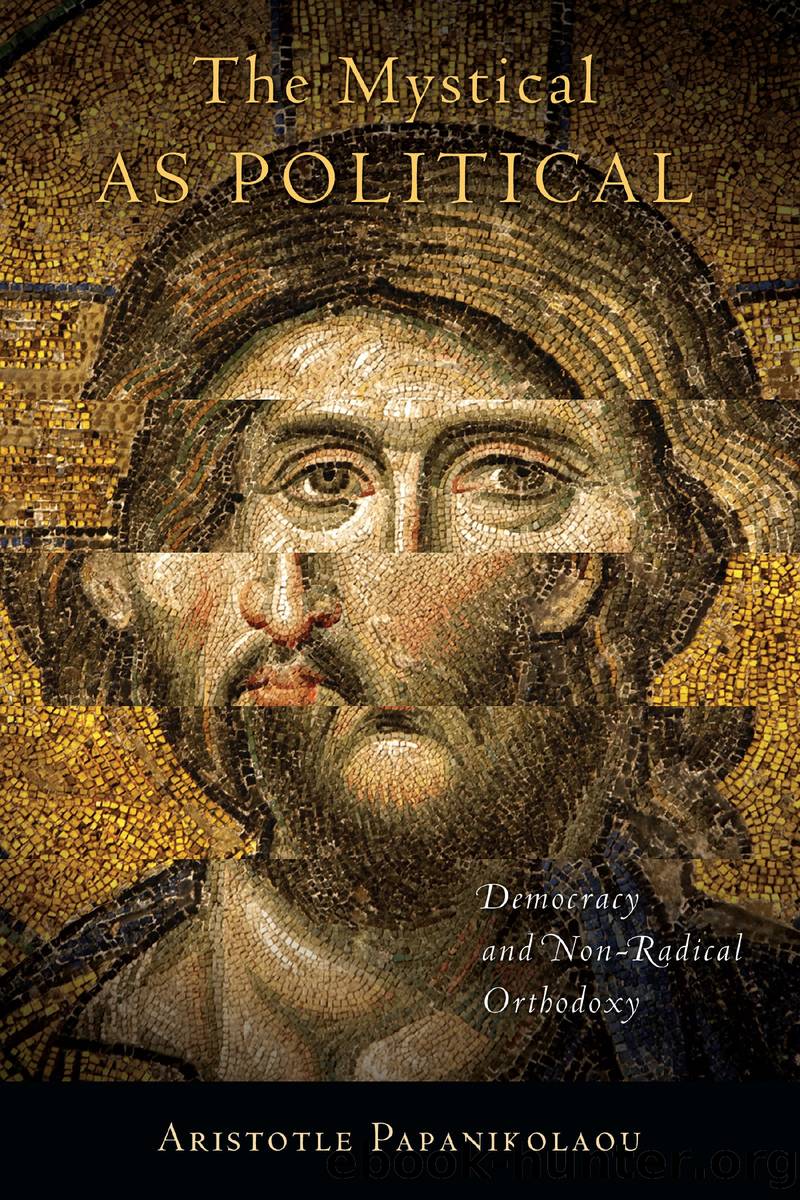
The Mystical as Political by Aristotle Papanikolaou
Author:Aristotle Papanikolaou
Language: eng
Format: epub
Publisher: University of Notre Dame Press
Published: 2021-02-27T03:24:51+00:00
Christos Yannaras
The general contours of Losskyâs theology of personhood, together with his attack against neo-scholasticism, are all prominent in the thought of Christos Yannaras. Yannaras affirms all that Lossky does about personhood in terms of irreducibility, freedom (ecstasis), and love. He adds, however, three distinctive elements: (1) an engagement with Heidegger, who, he argues, provides the justification for a reappropriation of Dionysian apophaticism; (2) an identification of ecstasis with eros; and (3) a much more explicit rather than implicit, as it is in Lossky, identification of person as a relational reality.
Heideggerâs singular contribution to the history of philosophy, according to Yannaras, was to discern how philosophical discourse on the question of God is essentially âontotheological.â God was reduced to the first cause of creation, but, as such, was reduced to the highest âthingâ within creation, thus leading to conceptual idolatry. Heideggerâs critique thus opens the door for a revival of Dionysian apophaticism that emphasizes knowledge of God as an experiential event. Apophaticism regarding the knowledge of God is really an apophaticism of the person insofar as the event of communion between God and humans is one between persons. In such an event, humans are encountered as uniquely irreducible to nature, and hence to conceptual knowledge; they are constituted as unique and free beings in relations of freedom and love with the trinitarian persons who eternally exist as a communion of persons.53 Yannaras much more explicitly crosses the apophatic boundary between human and divine personhood in drawing an analogy between the persons of the Trinity and human personhood. This allows him to emphasize the element of relationality in personhood: imago dei becomes imago trinitatis for Yannaras, which means that personhood is not a quality of human nature but a relational event analogous to the communion that exists between the persons of the Trinity. Humans can image the life of the Trinity only in community, specifically, the ecclesial community, that is, the Eucharist.
The knowledge in the experience of union with God is, according to Yannaras, an âerotic affairâ and the âgift of an erotic relationship.â54 Person is an event of freedom, or ecstasis, from the limitations of nature in a movement of love, which Yannaras identifies with eros. This movement is simultaneously a self-transcendence from the limitations of nature, a self-offering to the other, and a desire to be united with the other for the sake of the other.55 Eros is a divisive and acquisitive force only in fallen humanity; when redeemed, it is a unifying force that does not annihilate but constitutes true otherness. Creation itself is a manifestation of Godâs eros, a desire for loving union with what is other than God and which inflames the human desire for return to God.
Download
This site does not store any files on its server. We only index and link to content provided by other sites. Please contact the content providers to delete copyright contents if any and email us, we'll remove relevant links or contents immediately.
| Anthropology | Archaeology |
| Philosophy | Politics & Government |
| Social Sciences | Sociology |
| Women's Studies |
The remains of the day by Kazuo Ishiguro(8961)
Tools of Titans by Timothy Ferriss(8357)
Giovanni's Room by James Baldwin(7309)
The Black Swan by Nassim Nicholas Taleb(7095)
Inner Engineering: A Yogi's Guide to Joy by Sadhguru(6780)
The Way of Zen by Alan W. Watts(6587)
Asking the Right Questions: A Guide to Critical Thinking by M. Neil Browne & Stuart M. Keeley(5747)
The Power of Now: A Guide to Spiritual Enlightenment by Eckhart Tolle(5738)
The Six Wives Of Henry VIII (WOMEN IN HISTORY) by Fraser Antonia(5492)
Astrophysics for People in a Hurry by Neil DeGrasse Tyson(5172)
Housekeeping by Marilynne Robinson(4429)
12 Rules for Life by Jordan B. Peterson(4297)
Double Down (Diary of a Wimpy Kid Book 11) by Jeff Kinney(4256)
The Ethical Slut by Janet W. Hardy(4235)
Skin in the Game by Nassim Nicholas Taleb(4229)
Ikigai by Héctor García & Francesc Miralles(4228)
The Art of Happiness by The Dalai Lama(4118)
Skin in the Game: Hidden Asymmetries in Daily Life by Nassim Nicholas Taleb(3983)
Walking by Henry David Thoreau(3946)
